
The Early Evening Social: A Growth Lane for Venues, DJs, and Modern Hospitality
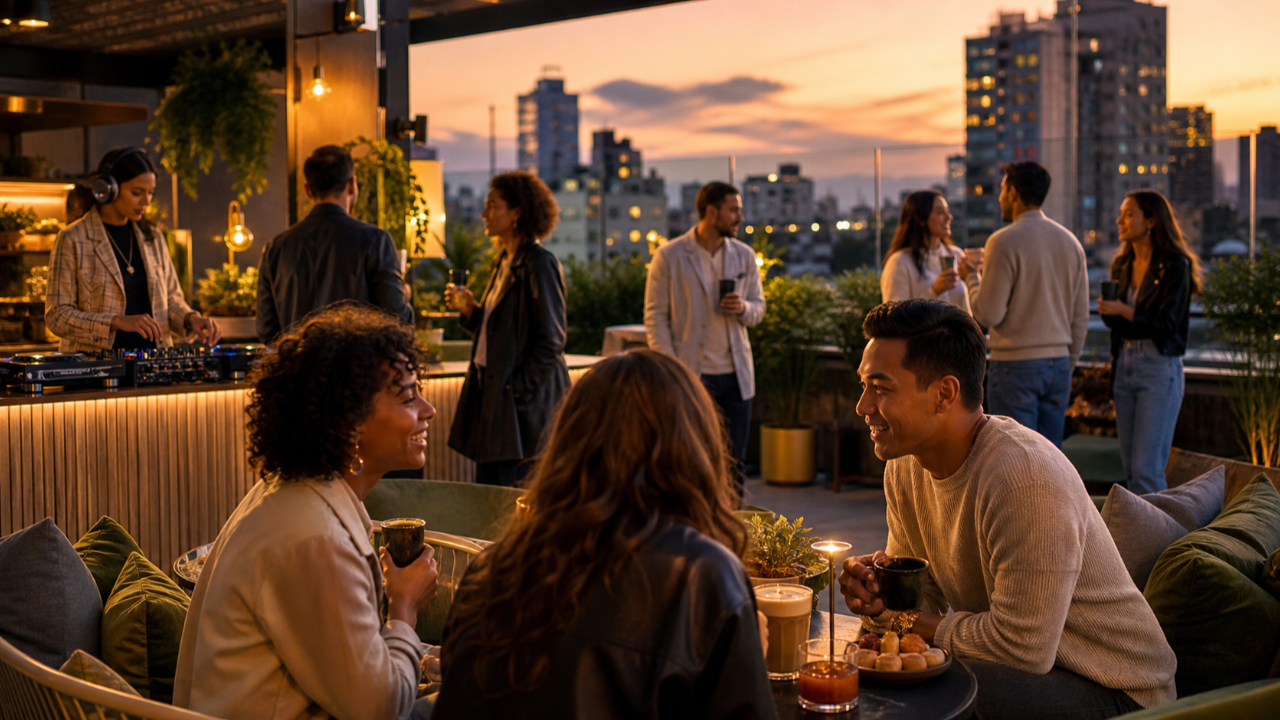
The Early Evening Social: A Growth Lane for Venues, DJs, and Modern Hospitality
Not every valuable social experience has to start at midnight. I know nightlife people do not always want to hear that. We love the late-night energy. We love the moment when the room is full, the DJ is locked in, the lights are right, and everybody can feel the night turning into a memory. That will always matter.
But the industry is changing. People still want to go out. They still want music, connection, celebration, flirtation, networking, discovery, and that feeling of being part of something. They just do not always want the same format. They do not always want to wait until 12:30 AM for the room to start, and they do not always want the night to revolve around bottles or a full late-night mission.
That is why the early evening social is becoming one of the most interesting lanes in modern hospitality. If you are a venue, DJ, promoter, restaurant, lounge, coffee concept, wellness brand, hotel, rooftop, or community builder, you should be paying attention.
Nightlife isn't dying. It's evolving. Sometimes that evolution looks like a dance floor at 1:00 AM. Sometimes it looks like a packed room at 7:30 PM with great music, better hospitality, strong conversation, and people who actually came to connect.
The 6 PM to 9 PM window is underrated
There is a window in the day that a lot of operators still do not respect enough: after work, before dinner gets too late, before the club crowd comes out, before people get tired, and before the weekend turns into a full production.
That early evening window can be powerful because it meets people where their life actually is. Someone can come after work and still be home at a reasonable time. Someone can stop by before dinner. Someone can meet new people without committing to a late night. Someone sober-curious can enjoy the environment without feeling like the whole point of the room is alcohol. Someone who loves music but does not want a packed nightclub can still feel culture. Someone new to the city can find community without having to decode the late-night scene first.
That matters. The future of nightlife and hospitality is not only about later. It is also about better timing.
This is not just happy hour with better branding
Let me be clear. The early evening social is not the same thing as a lazy happy hour. A happy hour is usually built around discounts. The early evening social should be built around identity.
Who is it for? What kind of people should be in the room? What is the promise of the experience? Is it for creatives, hospitality people, founders, DJs and music lovers, single professionals, wellness-minded guests, coffee and cocktail culture, members of a local community, or industry people who need a place to connect before the night begins?
If the only hook is cheap drinks, you are not building a new lane. You are just discounting an old one. But if the hook is connection, taste, music, hospitality, and timing, now you have something that can grow.
The music still matters
Do not make the mistake of thinking early evening means background energy only. The music matters. It just has a different job. At midnight, the DJ may be trying to raise the room, create momentum, and eventually push people into a bigger release. At 7 PM, the DJ is shaping conversation, pace, taste, and identity.
That is a skill. The right early evening DJ understands restraint. They know how to create a room that feels alive without making conversation impossible. They know how to make people feel like they are somewhere curated, not just sitting next to a speaker. They know when to warm the room, when to lift it, and when not to overpower the experience.
For DJs, this is an opportunity. Not every opportunity is a peak-hour set. Some opportunities are about becoming the sound of a community. If you can help a venue build a weekly early evening property, you are not just getting booked. You are helping create a brand asset, and that is a different level of value.
The room has to be designed for connection
If you want an early evening social to work, the room cannot feel like it is waiting for something else to happen. That is one of the biggest mistakes. Some venues open early, turn on the lights, put a DJ in the corner, and wonder why it does not feel special.
The room has to be designed like the early evening is the main event. The seating matters. The lighting matters. The greeting matters. The first drink or first offer matters. The way people enter the room matters. The music volume matters. The host matters. The flow between standing, sitting, ordering, meeting people, and moving around matters.
People should not walk in and feel like they arrived too early. They should feel like they arrived on purpose. That is hospitality.
Build the offer beyond alcohol
Alcohol can still be part of the experience, but it should not be the only value driver. The early evening social gives venues and operators room to build a smarter menu: zero-proof cocktails, functional drinks, coffee drinks, tea service, small plates, dessert, wellness-friendly options, low-ABV cocktails, premium water, tasting flights, and member-only specials.
The point is not to remove nightlife energy. The point is to give more people more ways to participate. That is what modern hospitality requires. Some guests will drink. Some will not. Some will come for music. Some will come for conversation. Some will come to meet people. Some will come because it feels like a better version of networking. The operator's job is to design an experience where all of that can coexist without the room feeling confused.
Promoters need to sell the promise, not just the time
If you are promoting an early evening social, do not just say, "6 to 9." That is a schedule. It is not a reason to care. Sell the promise: "A better after-work room for hospitality people," "Music, cocktails, and conversation before the weekend gets loud," "A coffee-to-cocktail social for creators and founders," "A rooftop mixer for people who still love nightlife but want something earlier," or "A curated early evening room for DJs, operators, and culture builders."
Now people understand the identity, and identity is what makes people invite others. When the promise is clear, guests know who to bring. When the promise is vague, they scroll past it.
The follow-up is where the community starts
The early evening social is not only an event. It can become the front door to a community. That is the bigger opportunity. Because early evening events often create more conversation than late-night events, they give you more chances to actually know the people in the room.
Who are they? What do they do? Why did they come? Who did they bring? What are they looking for socially? What would make them come back? What would make them become part of the brand beyond one night? Capture that, follow up, invite them into the next one, ask a real question, and introduce them to the community. Move them from attendee to regular, regular to member, and member to connector. That is how a simple early evening event becomes a real growth engine.
This lane is wide open for serious operators
The early evening social is not for everybody. Some people will treat it like a side project and quit after two tries. Some will make it too generic. Some will think a pretty flyer is enough. Some will underpay the DJ, understaff the room, forget the hospitality details, and then say the market is not ready.
That is not the market's fault. That is a design problem. For serious operators, this lane is wide open. Venues can use it to create new revenue without forcing every night to become a nightclub night. DJs can use it to build a tastemaker identity and consistent relationships. Promoters can use it to reach people who do not respond to traditional late-night marketing. Restaurants and lounges can use it to turn slow windows into culture. Coffee brands and wellness brands can use it to enter hospitality without pretending to be nightclubs. Community builders can use it to bring people together in a way that feels modern, social, and sustainable.
That is the future I see. Not one version of nightlife replacing another. More lanes. Better choices. Smarter experiences. Stronger communities.
If you are building in nightlife and hospitality, start looking at your week differently. Do not only ask, "How do we fill Saturday night?" Ask, "Where is there a social window nobody is owning yet?" That question can open a new business.
And if you want to learn how to design those kinds of modern social experiences with other people building in the same direction, join the Nightlife Entrepreneurs Members Community. The future of nightlife and hospitality will not be built by people copying the old playbook harder. It will be built by people who understand culture, community, timing, and smarter choices.
Stay connected with news and updates!
Categories
All Categories
Have you read it?
Julio talks about his journey from being an immigrant at an early age and not being the most popular, not too confident and not having a clue about this Industry all the way to becoming the expert he is today. If this book doesn't motivate you to dive into the industry head first we don't know what will.
Nightlife Isn’t Dying. It’s Evolving.
A survival guide for the new hospitality industry. Julio Mario Zambrano explores how culture, community, changing consumer habits, and smarter operations are reshaping nightlife.